Sunday, April 17, 2016

Wha' Happened in Oaxaca: Day 3

From March 10th until the 20th, I was part of a delegation of Land Stewardship Project members, organized by Witness for Peace, who met with farmers and non-governmental organizations (NGO's) in the state of Oaxaca in southern Mexico. I'll be posting a recap of each day on this blog.

Agave plants at Real Minero
That morning's Check-In featured the first official outbreak of tears on the trip, which was a relief to me. I'd been waiting for someone to break the emotional seal. It made me more comfortable about opening up thereafter.

That day’s program began at the Real Minero mezcal distillery (palenque) and farm, located in a village out in the boonies. Our bus pulled up to a park next to the distillery, where a pickup basketball game was going on. When one of the teams scored, we cheered from the bus. The players didn’t react, so I wasn’t sure if they didn’t hear us or they were just trying to play it cool.

There were chickens on the grounds, and the ground was mostly dirt and liberally populated with agave plants, big ones. The buildings were either new and pristine or traditional and elaborate. According to our guide, there's a prejudice against rural people living well, but she said it's worth the hostility to make a nice space for their work.

The woman in charge of the distillery, Graciela, led the tour. Her grandfather made the unusual decision to leave his farm to her instead of a male relation. The only way to buy land in this place is to be born here. This custom is meant to preserve the sanctity of the land.
Liz with Graciela and Santiago

Land is sacred to the indigenous communities of Oaxaca. The earth is a living being, part of the family. On the way there, we saw stone-and-brick pedestals in the fields, placed in seemingly random spots. Graciela said those are where people perform rituals to ask for water or give thanks. Many rituals have disappeared, but some have survived. There are also 15 different ethno-linguistic groups in this area, essentially 15 countries in one territory. This leads to conflict over sacred spots.

Land belongs to everyone and no one. The community gives one day’s worth of planting to people who want to farm, approximately one hectare. Most farmers have around ¾ hectare. Where agave grows wild, the indigenous people who belong to that forest or mountain can harvest and sell it, but others can't. This farm only grows about 2% of the agave they use in the distillery.

The agave is native to Central America. Linnaeus named it after the Latin word for “admirable.” Maguey is the common name in Spanish. There's enough room for annual crops in between the plants, making it ideal for polycultures. Agave both gives seed and reproduces through the roots. They plant it by seed in small rows before moving it to its final field at the beginning of the rainy season.
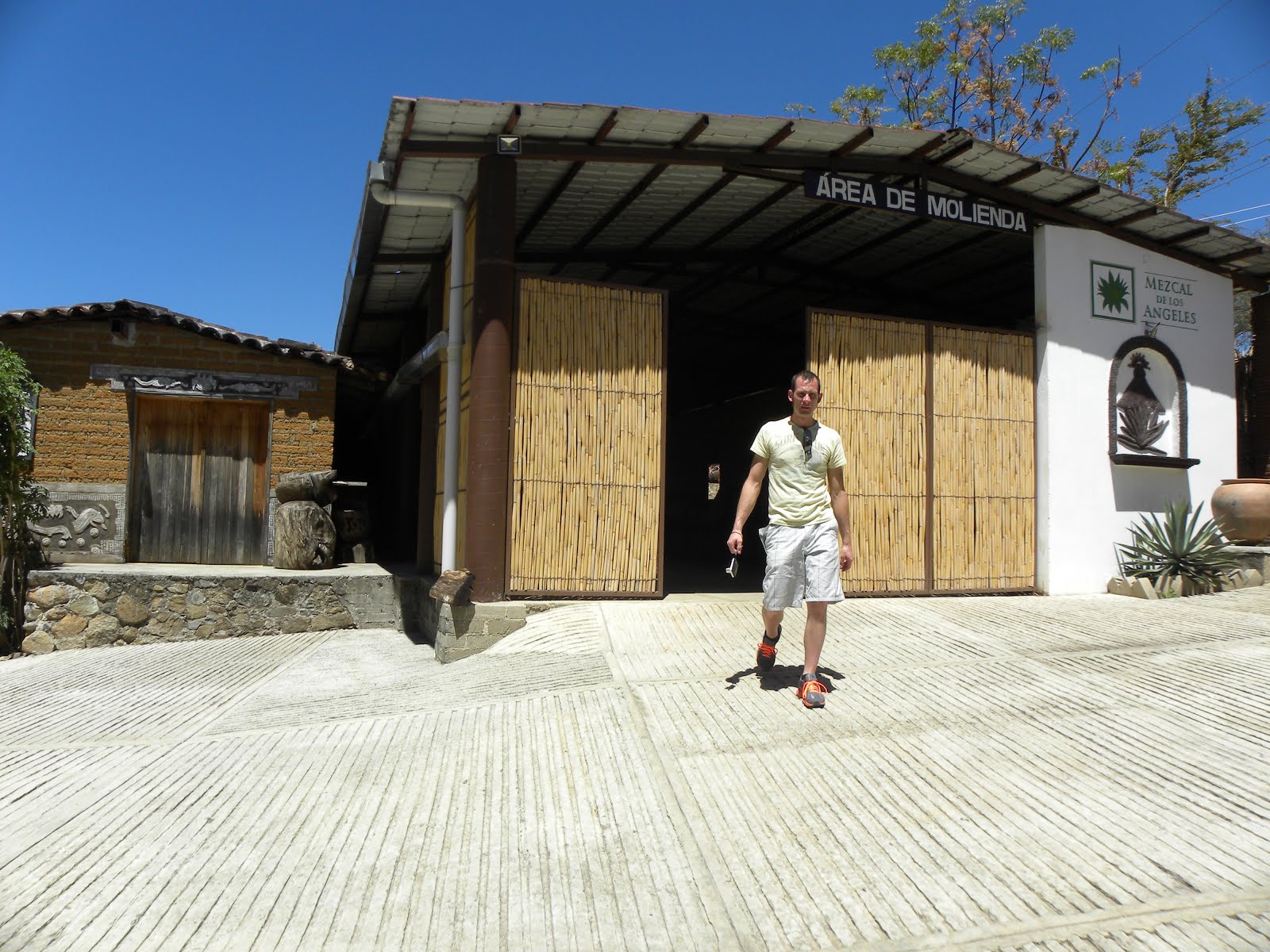
Nolan at Real Minero
There are many varieties of agave, 200 total and 156 in Mexico, about 30% of which are in Oaxaca. The different varieties grow in different microclimates. The American agave takes 20 years to reach maturity and weighs up to 400 kg. Other types are much smaller, but most take at least 7 years to reach maturity. Some are good for putting on fences; others are best planted in circles in the fields.

Every part of the plant can be used. The flowers and stems are edible. Fibers can be extracted from the leaves and sugar from the heart. (Hidalgo is the state in Mexico where agave fibers are still used.) The leaves are also used as house roofs and the stems as house beams.

There are drinks derived from agave other than mezcal. Agua miel is the freshly extracted agave juice, full of vitamins like B-12. Pulque is a fermented beer-like beverage, mostly from the state of Puebla. Before the Spanish arrived, there was no milk, and pulque served a similar function. The arrival of beer killed the pulque industry in Mexico.

Pit where agave hearts are roasted.
Now corporations from Jalisco are buying all the agave they can find for miel de agave (agave nectar), which is not sustainable. In Jalisco, corporations also rent land to monocrop agave. (Monocultures showed up in Mexico in the 1940s.) The system is more tecnificado (mechanized). There are intermediaries (coyotes) now, so small farmers don't control prices.

Mezcal production was illegal until 30 years ago; various laws prohibited native drinks. Graciela's grandfather went house-to-house, selling in bulk. It takes 5 years to learn how to make mezcal, like going to college. This distillery started in 2006. They had to find work for women in the process as well as men.

The most valued agaves for mezcal are complex in flavor and aroma. There are usually mixed varieties of agave in each batch.

I smell El Dos ("The Two"). (Not poop.)
To make mezcal, the agave is always harvested at biological maturity. Six months after cutting the flower stalk, the heart is harvested. What is not used for mezcal can be used as fuel, leaving no waste.

The roasting oven is pre-Hispanic (pre-Columbian) technology. Rocks and coal are placed at the bottom of the dug-out cone. The rocks can absorb a lot of heat. They use large pieces of wood to make a hot fire. The wood they use is often donated or left over from forest management.

The rocks go over the fire, taking 10 hours to reach the desired temperature. Then they put fiber over the stones for insulation and agave on and around the fibers. Their oven has a capacity of 13 tons of agave hearts.

Graciela with distillation pot
The roasting agave is covered with a tarp (which can be made of palm leaves) and soil, with some water under the tarp. It cooks in five days. This process turns the starch to sugar and gives the mezcal a smoky flavor. It takes 5-8 people when done by hand. Since it takes about a month to make a batch of mezcal, they fire about twice a month to keep it flowing. The goal is to have constant work throughout the year.

Five days after taking the agave out of the oven, they grind it. The burnt and bad-flavored parts have to be trimmed off. Then, either 2 men work it over with big pestles (One vat takes 8 hours.), or they send it through a mechanical grinder. Agave is pretty acidic; we can see the evidence where the grinding is done.

The ground agave spends 3-4 days in the first container. Water is added on the 4th day. It takes 8-10 days to ferment after that. Both the fiber and the juice ferment; more mechanized processes extract the juice first. “Our processes aren't domesticated,” Graciela explained. fermenting, there's about 8% alcohol, and it tastes like beer.

Distillation pot
For each barrel they light 3 stills. They have to start the distillation at the right time; otherwise, the liquid will turn to vinegar. Distilling takes 2-3 days and nights. The process is called Philippine distillation, with 2 clay pots and a copper round-bottomed lid with cold water in them to create the condensation, which drips into a wooden spoon leading out of the pots.

There are 4 parts to the extraction: the punta, which they throw out because it has the wrong kind of alcohol in it; the heart; the tail and the last bit, which they use only to wash the floor. They get 55 liters per ton of agave with a good yield. Their distillation ends up with 38-55% alcohol. Sometimes they distill a second time, such as with mezcal de pechuga, for which they put dried fruit and a raw chicken breast in the second distillation.

They use the left-over fibers to mix with earth and make adobe, or make paper, forage, compost or fuel.

They never took loans from a bank, and all the profit is reinvested in the project.

Lunch at Real Minero
During the tour, Graciela’s little boy, Santiago, was hovering on the edge of our group, trying to peel people away one at a time to play with him. I was never picked as a potential playmate, which was a little disappointing. But I wasn’t really interested in the lecture, so I probably didn’t look like much fun.

We sat at a long, L-shaped table for lunch. There were 4 different flavors of mezcal for us to sample, a shot at a time. I had to stop after the third.

After lunch we returned to the hostel and discussed immigration. I talked about getting pissed off by my former employer, a certain large, financial octopus bringing Indian clerks to Minneapolis. I’ve been very reluctant to tell people about that, as detailed in an old blog post, My Job Made Me Racist. Strangely enough, I'd told Charlie about it the night before in our room as we were getting ready for bed.

That evening I joined Paul, Sara, Hannah, Nolan and Andrew (I think) to climb the hill that the hostel was at the bottom of. Somebody wanted to see the big amphitheater at the top. We’d asked Maggie about it the first (or 2nd) morning. She said it lost its cover because the construction company used shoddy material. Without that background, it looked like a fancy observatory instead of a glaring example of government corruption.

We climbed some steep, cobblestone streets through a poor neighborhood. Later, Maggie said if she'd known we were going up there, she would've suggested a different route, because it's a rough part of town. On one of the steepest streets, I looked into an apartment; the curtain covering the door had been pulled to the side. It looked poor, but they had some nice audiovisual equipment.

I wondered about their priorities or what goods and services have access to, assuming it was all acquired legally. Electronics may be more easily purchased (or stolen) than other, more basic necessities of the Good Life.

We had to walk under the last street to get to the amphitheater. There were murals in the passage, but I didn't recognize any of the historical figures included therein. The amphitheater turned out to be Oaxaca City's Inspiration Point. We kept passing teenage couples, most of whom were not making out, but they appeared to be looking for the right spot to start making out or waiting for us to pass.

We circumnavigated the place and took a different route back, down a long line of stairs lined with street lights, which was helpful since the sun had just set. There was a woman working in a garden along the path, with whom we spoke. Hannah did most of the talking, since she was the strongest Spanish speaker in the group. After the stairs, we weaved our way down streets, passing a building with a loud gathering inside that looked like either an evangelical church service or a game show.

There was also a currency exchange (casa de cambio) on our way. It was closed, but I was curious about the exchange rate, so I crossed the street to look. They had a chalkboard out front with the dollar-to-peso rates. It showed 16.66 pesos to the dollar, which was about 2 fewer pesos than the day before. I was struck by the volatility and the occurrence of “666.”

For dinner, I joined Andrew, Alan, Nolan and Hannah at El Trompo, a little taco place near the hostel. There was a TV showing a Mexican soccer match with several young men gathered around. I was concerned about the wait staff wearing masks. It didn’t fill me with confidence, but it was a common sight on street vendors and waiters in the city. I ordered a large dish called the Matahambre ("It kills hunger."), a name that proved prophetic. It was very good, basically everything on their limited menu, chicken, peppers and cheese with tortillas.

I switched to the downstairs shower on Day 2, but it wasn't until Day 3 that I realized the water dials were for hot and cold, respectively, knowledge of which considerably enhanced my showering experience.

I went to bed quite peacefully that night, little suspecting what fiendish plot was being hatched by the Mexican microbes that had recently gained residency in my gastrointestinal system. (Don’t worry; it wasn’t that gross.)

Tuesday, April 12, 2016

The Social Chameleon

I'm a social chameleon. This might come as a surprise, if not a shock, to people who know me, because I'm usually very reserved. But, if you pay extremely close attention to my behavior, you'll notice that I often adopt the speech and mannerisms of the people I'm around almost immediately.

I'll catch myself mimicking someone's laugh or tic or manner of speech, and I'll scold myself mentally, because it disturbs my sense of identity. If I'll abandon my personality at the drop of a hat, just because I'm with strangers, then what kind of person am I? What do I stand for? Will I stand for what I believe in or just go along with the crowd?

It worries me. This trait has always been in tension with my sense of justice and a certain contrarian streak. I know I'm just trying to get people to like me. Luckily, it's been an abject failure. People don't wanna hang out with someone who has no opinions of his own. If you change based on which way the wind's blowing, then you'll be left with nothing, no friends or personality or soul of your own.

Woody Allen addressed this character trait in Zelig. The title character transforms physically as well as socially to blend in with whatever group he happens to be in.

Jorge Luis Borges wrote about Shakespeare talking to God at the end of his life. Shakespeare says, "I who have been so many men in vain want to be one and myself." God says, "Neither am I anyone; I have dreamt the world as you dreamt your work, my Shakespeare, and among the forms in my dream are you, who like myself are many and no one."

This may be an actorly habit. I also chalk it up to my eclectic tastes, but I suppose we all have to run in different circles depending on the occasion. It's not easy being a leftist intellectual who's also a sports fan with an oft-juvenile sense of humor.

But isn't that the Human Condition? I'm often amazed and bewildered by the diversity of my interests, but it never seems to impress anyone else as much as it impresses me. And, then again, why should it? Those who dedicate themselves to one pursuit alone are the true objects of fascination. The natural state of our fancy is multicolored, not monochromatic.

I'm glad to say that I don't copy other people's quirks nearly as much as I used to. This may be a result of growing confidence, maturity or just getting old and inflexible.

Sunday, April 10, 2016

Wha' Happened in Oaxaca: Day 2

From March 10th until the 20th, I was part of a delegation of Land Stewardship Project members, organized by Witness for Peace, who met with farmers and non-governmental organizations (NGO's) in the state of Oaxaca in southern Mexico. I'll be posting a recap of each day on this blog.

I was much better-rested than the day before, which helped a lot. Breakfast was followed by Check-in and Reflection on the roof. We took 6 taxis to the first location. I should've known something was wrong when the cabbie asked if we were going to Monte Albán, a local archaeological site. (We were visiting a completely unrelated NGO.)

At the wrong place, before the truth sets in.
Our taxi dropped us off at what looked like a school. We were one of 2 carloads taken to this compound with a mural of a crest that mentioned something about the police. We figured we were early or the others were lost. It was about 15 minutes before we realized we were the lost ones. The guard at the gate came over and spoke with Aaron. Sue told him not to mention Witness for Peace, which I thought was paranoid, but in hindsight may have been wise. There were teenagers loitering by the entrance, which is what gave it the appearance of a school.

We got on the horn with the other folks and learned we were off by a mere 2 blocks, so we walked to our original destination, EDUCA (which stands for the Spanish equivalent of "Services for an Alternative Education"). It was housed in a much smaller 2-story building, but still had a wall and a formidable door. I didn't like being cooped up in a classroom on such a nice day, but I enjoyed the subject matter.

Alan speaks up at EDUCA as Sue Ellen and Terry look on.
EDUCA was formed in 1994 to promote civil participation, indigenous rights and indigenous leadership. That year was a turning point in the history of Mexico. NAFTA took effect and, in response, the Zapatista uprising began and Mexican civil society emerged. EDUCA was inspired by the Zapatistas to organize indigenous communities on the local level. There are 10,000 such localities in Oaxaca.

The speaker, Miguel Angel Vásquez de la Rosa, outlined 6 Pillars of Indigenous Resistance: language (the indigenous mother tongue), territory (80% of Oaxacan land is communally owned.), the community assembly, community work (tequio, which is unpaid), volunteer positions (cargos) and celebration (fiesta, na-doy).

EDUCA
They've come up with a word for the government they want to create: "communalocracy," rule by the community. The word "democracy" has been discredited by its association with the Mexican (and U.S.) establishment. They want to replace the nexus of corporate and government power that has impoverished Oaxaca, especially its indigenous inhabitants.

The Mexican government has been supporting energy and mining mega-projects in Oaxaca. These have ruinous environmental and economic consequences for the locals, even the wind farms and hydroelectric dams. The overriding effect (and, likely, the purpose) of these projects is to dispossess indigenous people.

This has led to emigration from Oaxaca to northern Mexico and the U.S., which has caused disintegration of the social fabric, poverty and violence. Even many of the Tachuatl, or "Snake People," the traditional guardians of the land, have been forced to leave. EDUCA believes these issues can be primarily remedied on the local level.

Pochote organic market
Thence, we took another fleet of taxis to Pochote organic market. I struck up a conversation with our cabbie, asking Sue what the word for "driving" was and carefully forming the sentence in my head: "Manejar es mucho más fácil en los Estados Unidos." ("Driving is much easier in the United States," I think.) The driver seemed to agree, although I couldn't quite make out his reply. Sue spearheaded the rest of the chat, as her Spanish skills far outstripped mine.

At one point, she was struggling to translate something he said for the rest of us, when he interrupted her to explain it in English. She playfully scolded him for hiding his English skills from us. He claimed his English was poor, but he sounded fluent. The discussion flowed more smoothly thereafter.

Eric and Rick at Pochote market.
He'd lived in Mexico City until the age of 4 when his dad split and his mom returned home to Oaxaca. Sue said, "Qué lástima." ("How sad.") As we paid him 50 pesos and bid him adieu, I wondered if we could've done more to help him. People in need pass through our lives all the time, and we rarely take the time to make even a token effort.

The needy in Mexico were more obvious and numerous than those back home, but poverty in the Twin Cities has become more visible in the last few years. There are so many needy and so few rich wherever you go. I think spare change can help, but big change, like repealing NAFTA, is what's really needed.

The Pochote market was in a picturesque old square with a church. There were two guys with a marimba, and Rick asked them if they knew the name of a Mexican song he'd been trying to identify. He hummed a few bars for them. One guy recognized it and played some of it, telling him the name. I asked the name of another song they played, and the other guy said, "Cielito Lindo," a famous traditional song also known as "The Ay, Ay, Ay, Ay Song" (according to Wikipedia).

Debra at Pochote market.
We had lunch at the tables in the middle of the plaza under a tree. I mooched some ceviche off of Liz and Debra and something like fried tortillas off of Sue. I felt kinda guilty about that, but the ceviche was damn good.

We listened to two speakers there. The first was a woman who wrote a book on nutritional sovereignty in 2000, with recipes from the Mixe region. She said food involves many cultural elements: music, dance, celebration, mutuality. “Food is life. Food is knowledge.” Food gives us strength, health and unity. Food is sacred. They don't waste it. Even if a grain of corn falls, they pick it up and use it. They ask permission from the earth to produce the food and throughout the process. They thank the earth and interact with nature. They talk to the rain and to the earth. They give gratitude when they eat and when they harvest.

Quinceañera party
Food reinforces community organization. Kids participate, older folks measure out ingredients, women cook, men bring chairs and firewood. There are four kinds of food: common food, curing food, ritual food, celebration food. Mixe food is spicy and hot, with not much oil. Medicinal food includes broth, armadillo shell, different plants and stems. Ritual food is often different kinds of tamales for different ceremonies: the corn ceremony to give thanks for the harvest, at weddings for the parents of the bride out of her sight, for the Day of the Dead or for wakes. Festive foods include bean tamales and chicken soup. Unfortunately, traditional food is being displaced.

Oaxaca Cathedral
Then a local producer told us that the market performs an important function for campesinos and local farmers. He explained that it's difficult to organize a market like this with the transnational corporations dominating the economy. But they have managed to create this space for themselves locally.

He talked about how organic agriculture tries to transform nature in ways that aren't aggressive. Through this approach, producers are spiritually, economically and socially strengthened. Going to a market rather than a supermarket makes us more human; it links us together. We shouldn't be disconnected from the earth. These farmers cure their animals homeopathically, use their manure for compost and use their own saved seeds in double-dug beds.

Customers try to haggle, and the vendor has to explain why the food is worth the marked price. Sometimes the supermarket lettuce is actually more expensive than at the market. The farmers also eat what they produce; the excess is for market. They believe it's better to eat food without pesticides and that it's possible for everyone to grow food. They try to spread the message by sharing food and information.

The convent
After those presentations, we continued touring the market. Karissa and I visited the booth of a middle-aged woman with a clearly Western European accent. I didn't have the guts to ask where she was from; I thought she might be on the lam. (Seriously.) She asked if we wanted to try her "special creation." Karissa enthusiastically expressed her interest. I was more cautious, afraid my Minnesota Nice would compel me into my first psychedelic experience. But it turned out to be just pumpkin seed butter. It was good, like organic peanut butter.

From there, we walked to the convent to perform "NAFTA Reader's Theater," which sounds like the worst PBS public affairs show ever. But we got to put on costumes and act, so it wasn't all bad. (Unfortunately, the CEO's mustaches were a dud.) Hannah led us in a few songs for our Reflection. They were kinda hippy-dippy, as Hannah admitted, but it was nice to sing together. That's when our bonding seemed to manifest most clearly.

Folk dancers in the zócalo.
Then it was back to the hostel. I mustered the courage to go out on my own for the first time to buy soap so I wouldn't have to keep borrowing Andrew's. (I probably could've kept using Aaron's shampoo, but my conscience wouldn't allow it.) The cashier had just sat down for a rest when I walked up, but he smiled, got back up and we had a nice little exchange. He deduced that I was a gringo and helped me out with some English. It was a stark contrast from the behavior of most convenience-store cashiers in the U.S.

Mairi, Aaron and Sue Ellen in the zócalo.
We all went out to dinner that night at a restaurant on the nearby zócalo. The waitstaff pushed a bunch of tables together for us. People, who mostly looked indigenous, would come up to us on the patio selling wares. If you wanted to avoid the poverty, you had to sit inside. Aaron paid for a song from a guitar player, which was quite good and sounded electric, even though it was an acoustic guitar. (Apparently, 12-string guitars can sound electric.) The food was OK, but not as good as the hostel staff's breakfasts and lunches.

After that, we wandered the square, which was full of people. Even at 10 pm on a Saturday night there were a lot of families. People were dancing (in couples!) in bars. Indigenous women with babies were selling textiles or candy. In the shadow of the church, we made a circuit around the zócalo.

The zócalo after dark.
One side of the square must've been a government building. It was old, like all of the surrounding buildings, but it also looked abandoned. There were barriers in front, and a group sat on the steps with banners. I couldn't decipher them, but I'm guessing they were petitioning the government for a redress of grievances. Or something like that.

There seemed to be a disco next to the hostel, because we heard dance music late each night as we tried to sleep. It wasn't loud, but that kind of thing usually drives me crazy. In this case, though, I didn't really mind. Also, Karissa gave me earplugs, so that helped. (I was going to say she "lent" me earplugs, but that didn't seem accurate, as I don't think she wanted them back.)

Saturday, April 2, 2016

Wha' Happened in Oaxaca: Day 1


From March 10th until the 20th, I was part of a delegation of Land Stewardship Project members, organized by Witness for Peace, who met with farmers and non-governmental organizations (NGO's) in the state of Oaxaca in southern Mexico. I'll be posting a recap of each day on this blog.

A hostel breakfast.
I woke up a bunch of times that first night, so I wasn't real chipper for my first day in Oaxaca. But I soldiered on through breakfast, putting a happy face on my sleep deprivation and anxiety. I’ve found that staying engaged with people gives me energy. An actor in one of my shows diagnosed me as an extravert, which was surprising. It doesn’t mean that I’m outgoing, just that I get my energy from interacting with people. As a friend later said, I have the misfortune of being a shy extravert. 

The hostel workers made us some great breakfasts and lunches during our 6 days there. Apparently, that wasn't part of their normal job description, but they really went above and beyond the call of duty. There were all kinds of local delicacies, and only a few were too spicy for me. I wasn't blessed with a cast-iron stomach, but so far I've avoided my mom's fate of relying on a food pyramid of Jell-O, PBJ’s and flat Coke. 

The dining area was another atrium mostly covered with a white screen. There were wooden chairs and tiny wooden tables, each seating 3 or 4 of us as we shrank our American sense of personal space. I began the process of chipping away at my social anxiety by making small talk, but mostly through listening, as is my way. 
Hostel dining area

Following breakfast was our first check-in, a group gathering on the roof in the glorious sunshine and slightly nippy morning air. Even though the hostel was only two stories tall, we had a panorama of the city, as only a few buildings exceeded 3 or 4 stories. The city of Oaxaca de Juárez spread out around us, overrunning hills and filling up the valley. Shanties climbed the steepest slopes, stopping well short of the summits. 

We stood in a circle throwing a ball around to determine whose turn it was to say why they'd come on the trip. I enjoy the structure of such activities and the audience it affords me, so those were invaluable for me to share my thoughts and feeling with the group. It's much easier for me to talk and open up emotionally when I have formal permission to do so. 

Check-In on the roof.
We took a bus to a farm out in the country, passing through many poor, rundown neighborhoods (colonias). We never did get to the ritzy part of town, but I’m guessing it exists, tucked away in a few heavily-fortified compounds. The city was poorer than I expected. It reminded me of Tijuana, where I spent a week in '94 on a mission trip through my Catholic high school. There weren't people selling chicle (gum) to cars at stoplights like in Tijuana, but there was more than enough poverty to go around. 

The family farm we visited was located on the edge of a town called San Juan Chilateca. (All the towns seemed to be named after local saints.) The farm was called Espacio Kruz, espacio being the Spanish word for "space" and Kruz being the name of the family who runs it. The buildings were made of adobe and a local cane that resembles bamboo, with plastic bottles in the door thresholds. Inspired by the Zapatistas, they've set up a center of grassroots resistance to government and corporate efforts to impose the neoliberal economic model locally, especially the precepts of NAFTA.
Our usual bus, parked by the hostel.

That trade deal mandated the policy of Descampesino (literally, “un-peasant”), emptying the countryside of small farmers. It’s been highly successful, thanks to the influx of cheap, highly subsidized staples like corn and flour from the U.S. Also, most land is collectively owned and could not be sold, until the government changed the law in ’94. That, combined with the Narcos’ violence, has accelerated emigration from Oaxaca to the U.S. and northern Mexico.

Sara and Paul at Espacio Kruz.
The patriarch, Román, did most of the talking, but his wife and daughter chimed in too. He talked about milpa, what we in the U.S. call the Three Sisters: the plant guild of corn, squash and beans. They're trying to preserve these traditional practices despite extreme economic and political pressure, and even violence, to sell their land or adopt the industrial agricultural methods of monocropping, chemical fertilizers, herbicides and pesticides.

Román said there are 65 varieties of corn in Mexico, but GMO corn has overtaken northern Mexico, displacing all native breeds. GMO corn is illegal in Oaxaca, although a “hybrid” strain is legal, allowing GMO a foothold in the state. Luckily, the hybrid seed is sterile. 

Me, Román, Maggie & Maria Elena at Espacio Kruz.
For lunch, they served us a soup of tomatoes, chicken, chiles and olives, with tortillas on the side. The chicken bones were a bit perilous, but otherwise it was a tasty meal. To drink there was juice (jugo) or tea. I had to adjust to the near-total lack of sweetness in Mexican juice. It tastes like they don’t add any sugar. (Kool-Aid would ruin this place.) Dessert was roasted squash, also unsweetened, but good, and a shot (or two) of mezcal, the agave-derived, tequila-adjacent alcohol for which Oaxaca is known.

Jasmin shows off a squash.
Our visit stretched well into the afternoon, the first of many instances when the Mexican concept of time was a drag on our schedule. But it was a lovely place with lovely people, so, despite my anal-retentive tendencies, I couldn’t really complain. We toured the gardens and saw radishes, quelites (edible weeds that comprise part of the milpa) and other plants. There was a demonstration milpa they were watering. (Normally, the milpa is planted in the rainy season, and we had clearly arrived during the dry season.)

We then returned to the city and went to a convent for that day’s group discussions. First was an  exercise to spur debate on the effectiveness of violence, followed by a round of “Consensus” decision-making to establish ground rules for discussion or, as Maggie put it, "Group Agreements." 

Lunch at Espacio Kruz.
Inwardly, I rolled my eyes. My favorite blogger, the Archdruid, took Consensus to task for crippling the Left for about the last 35 years and killing the Occupy Wall Street protest at Zucotti Park. But, in my neverending quest to not upset anyone (following in my mom’s footsteps), I held my tongue. The process actually allowed me to block a resolution, so I guess I can’t be too mad at Consensus. 

The resolution in question was for everyone to qualify our statements as personal opinions instead of facts. I felt this would be too discouraging to open debate, that we would be too worried about offending each other and over-censor ourselves. The group agreed to change the resolution to say we would try to frame our statements as opinions rather than facts. I was satisfied with the change.

Oaxaca City
After establishing a few more ground rules, we walked back to the hostel and went out into the world to fend for ourselves for dinner. Again, my memory of dinner has abandoned me. I don’t remember going out at all that night. 

I had no desire to stay out late due to my (relative) lack of sleep the night before, so I stayed in. I was one of 4 guys to move to another room upstairs for accommodations, where we had 6 bunkbeds between us, plenty of bottom bunks to sleep on and room to enjoy some of that American-sized personal space. 

Consensus decision-making at the convent.
Having the room to myself that evening, I indulged in some much-needed solitude and did my daily writing exercise: 3 pages of stream-of-consciousness, known in The Artist’s Way as the Morning Pages. I also had time for a much-needed shower, although I made the mistake of using the showers in our room despite being warned about the cold water. As it turned out, the water temperature wasn’t the real issue.

There were two showers in our bathroom. I tried the first, but turning the two dials only activated the sink faucets. It would’ve been hilarious to anyone watching. Unfortunately, I was not in a good mood. But, as Samuel Beckett apparently said, “Nothing is funnier than unhappiness,” so if someone had filmed me, I’m sure it would’ve gone viral. I was probably ripping off a Fatty Arbuckle routine without realizing it. 

Karissa admires our Group Agreements.
In the second shower stall, one dial again activated a sink faucet, while the other finally brought a meager measure of success. Most of the water came out in a fountain above the showerhead and brought precious little moisture to the body of the bather. 

I gasped a few times in the scattered spray, although my reaction seemed to have less to do with the coolness (or "coolth") of the water and more to do with finally letting my guard down with no one around. My anger and anxiety seemed to be leaking out under these extreme conditions, forced out by the frustration and discomfort of this showering ordeal.

Oaxaca City
I managed to wash off the film of sweat, grime and self-consciousness that had built up over the previous 2 days. It was a military-style shower (or “navy shower,” according to Wikipedia), which I learned during a week-long visit to Dancing Rabbit Ecovillage in NE Missouri (another group that practices Consensus). 

I ran the shower just long enough to get wet, which took longer than usual, then shut it off and lathered up before rinsing off. This approach uses much less water than the traditional First-World shower, and it comes in mighty handy when the water is cold. I rarely make that sacrifice in the fall and winter, but I often do it in the summer.

Finally free of that emotional baggage, I settled down early for a restful night’s sleep.

Saturday, March 26, 2016

Wha' Happened in Oaxaca: Day 0

From March 10th until the 20th, I was part of a delegation of Land Stewardship Project members, organized by Witness for Peace, who met with farmers and non-governmental organizations (NGO's) in the state of Oaxaca in southern Mexico. I'll be posting a recap of each day on this blog.

When I told people about the trip, they talked about how cool it sounded and asked if I was excited. I gave them an ambivalent "yeah," but they insisted that I'd enjoy it. I wasn't so sure. I was more anxious, even terrified, than excited.

Even in my native habitat I'm often plagued by social anxiety. This trip meant spending 10 days in a Third-World country where I didn't speak (much of) the language, lodged in close quarters with 20 people I didn't know. Just thinking about it occasionally made me break out in a cold sweat.

I only read one of the articles on our reading list, despite my interest in the subjects covered therein: geopolitics, economics, human rights, immigration, agriculture. As the departure date approached, I realized I was practicing what one of my former therapists called "avoidance." I didn't wanna think about the trip and, therefore, avoided anything that brought it to mind. My denial didn't give way until the day before I was to leave.

I took care of the packing I'd been procrastinating on and got a decent night's sleep. Luckily, my flight didn't take off until 2pm, so I had plenty of time to take the bus from my parents' house in the 'burbs to downtown Minneapolis and, from there, take the light rail to the airport. It was after rush hour, and I didn't have to fight any crowds. In fact, when I got to MSP at 11, it was almost a ghost town.

There was literally no line at security, which left me with hours to wander the terminal and write. The flight to Houston matched my mind-state: bumpy. I fluctuated between hope and my trademark pessimism. We got there a little early, which was good, because I’d only allowed an hour to make my connection. I navigated the Houston airport fine without any previous experience and had some time to kill in a Texas-sized lounge with a Texas-sized window with a lot of other people killing time on their Texas-sized phones, laptops and other devices.

The plane to Oaxaca was small, so we got to walk across the tarmac to get on, which still provides me a little vestigial thrill left over from childhood. The flight was another bumpy one, with the added bonus of an aerial display. We flew by a thunderstorm and got to see patches of cloud light up from the lightning underneath. It was like watching a silent battle from a safe distance (or what I assumed was a safe distance). 

We deplaned onto the tarmac at Oaxaca into a warm, slightly humid evening. The airport’s exterior was white and brightly lit, with vividly green grass around it. The scene had a Mediterranean feel. The alien March weather triggered a sense of disorientation. My guard went up, and I hit the bathroom, not just to relieve gastrointestinal urgency, but to get some privacy. 

Unfortunately, my sphincter clamped shut harder at the sight of the slightly unfamiliar lavatory design. I conceded defeat and went to the end of the customs line, which was just outside the airport doors, next to the tarmac. While waiting, a youngish man asked me if I was with the LSP delegation. I don’t know how he picked me out, but this was Aaron, one of my fellow delegates. We later found out we were the same age (38). With his beard, glasses, train engineer’s cap, jeans and denim shirt, he looked like either an organic farmer or a hipster who admires organic farming from afar. 

We chatted with each other and the customs officials. Aaron was proficient in Spanish. Our bags were re-x-rayed before we were allowed into the terminal. It’s a small airport, and there were only a few people left at 9:30 on a Thursday night. A slim, petite woman with short, curly, brown hair was holding a sign. She seemed to be our contact, but she was oblivious to us. Aaron asked if she was Maggie, and she said yes, surprised that we were the people she’d been waiting for. (It reminds me of a button on my guitar case: “We’re the ones we’ve been waiting for!”)

The culture shock really kicked in during the taxi ride. There were some stray dogs in the road by the booth at the exit to the airport parking lot. The driver honked at them, but they barely moved. He zipped through the pack, barely missing one.

Most of the drive took place on a Third-World freeway pockmarked with decay and neglect. At seemingly random intervals, the taxi would slow to a crawl and negotiate a large speed bump. I didn't see any signs for the speed bumps, so I figured the driver had their placement memorized. Riding in the front seat was akin to being in one of those old arcade video games like Cruis'n USA or Pole Position that encouraged reckless driving. In automotive terms, it felt like the Wild West.

Our progress slowed considerably once we got off the freeway and began wending our way through the local streets. Eventually, we stopped on a narrow side street and took our luggage to our hostel, Hostal Don Miguel. The facade was brick with two arched doorways containing gates. Maggie rang the doorbell, but it took about 5 minutes for someone to let us in.

Aaron and I were the last delegates to arrive. We walked through the lobby into an atrium of wrought-iron tables and chairs. Our room was right off the atrium. We went in and set our things down to make introductions, which were typical, no-frills, Midwestern affairs. All 11 men were in the same room with 6 bunk beds, so I was a bit uncomfortable, and there were only top bunks available. 

I don't remember much else about the first night, just hopping up on my bunk and taking a long time to fall asleep. There was talk of a snorer in the following days, but the (light) snoring wasn't enough to keep me awake or keep waking me up. That was the anxiety talking.

Thursday, March 24, 2016

Condiment Empires of the Eurasian Steppe

Author's Note: I performed this piece in The Encyclopedia Show on Sunday, March 20, at Kieran's Irish Pub in downtown Minneapolis. This month's theme was "Condiments."

While the Tartars were spreading a mixture of violence and terror across the steppes of Central Asia, they were also spreading a mixture of mayonnaise and green sweet relish on their fish. Their namesake sauce is just one of many condiments invented by the nomadic peoples of the steppes. But this truth has been buried by the “lame-stream” media at the behest of Big Catsup. The Powers That Be are afraid if people knew the exotic origins of their favorite condiments, it would rend the social fabric asunder, and the nation would be engulfed in an orgy of violence. Thankfully, I have no such qualms. Therefore, I will now correct this oversight, and may God help us all.

We know them merely as nomads or barbarians, savage brutes who subdued most of Eurasia through their superior use of the horse as a military vehicle. But the historians of previous eras called these groups the “Condiment Peoples” and referred to their period of preeminence as the age of the “Condiment Empires.” The nomads had a long-established tradition of flavoring their food after it had been cooked, and they imparted this knowledge to their vassals, who were equally terrified by their conquerors’ ferocity and intrigued by their seasonings. 

The administration of the Condiment Empires was lax in every area except condiment application. That was the one sphere in which the regimes had no tolerance for foreign traditions. As wave after wave of Condiment Peoples overwhelmed the civilized realms of China, India, the Middle East and Europe, they swept aside the old order and imposed their seasonings on the beleaguered citizens.

The variety of their condiments encompassed the full width and breadth of the human palate, but it was often their subjects who found new uses for them. The fishmongers of Persia were actually the first to apply Tartar sauce to seafood. What the Tartars lacked in culinary imagination though, they more than made up for on the battlefield. They are generally considered the fiercest of the Condiment Peoples, far outstripping the Worcestershires and the Grey Poupons in both archery and horsemanship. 

Many of our favorite condiments were championed by history’s greatest warriors. While establishing the largest contiguous land empire of all time, Genghis Khan simultaneously launched the world-conquering phenomenon of ranch dressing. His grandson, Kublai Khan, is credited with developing the formula still used in A-1 steak sauce. It is also believed that Marco Polo stole a jar of honey mustard from his court. And, despite its name, no one has done more for the popularity of Buffalo wing sauce than Attila the Hun.

The nomadic lifestyle lent itself to condiments and what we know today as “fast food.” Most contemporary fast-food franchises offer menus that would be startlingly familiar to the descendants of the Condiment Peoples. Kentucky Fried Chicken’s “Double Down” sandwich is actually a modern interpretation of the Seljuk Turks’ signature dish, “oghuz,” which means, literally, “I’ve given up.”

But the Condiment Peoples’ reign of tasty terror came to an end in the 15th Century. Condiment penetration had achieved maximum saturation in the Asian market, and Europe had recently rediscovered flavor after the bland, tasteless misery of the Dark Ages. The invention of the condiment-dispensing station by Giacomo Boiardi in 1471 brought flavor to the masses. This democratization of taste broke the monopoly of the Condiment Empires, and they soon faded from the scene.

They were succeeded by the Furniture Empires, foremost among these being the Ottoman Turks’, whose sole proviso was that their subjects place a cushioned stool in front of their chairs and rest their feet on it every once in a while, in the interest of “taking a load off.” The so-called “Edict of Relaxation” was naturally popular and contributed to the longevity of their empire. 

Some would say that the diffusion of condiment knowledge came at too great a cost. To them I would say, “Eh. Whatta ya gonna do?” Perhaps too many had to die, too many were orphaned or emotionally scarred for life so that we may know the joy of wolfing down a McRib, slathered in what I assume is barbeque sauce. But I fear to contemplate the alternative. What substandard, uninspiring fast food and condiments might we have inherited from our timid ancestors if not for the nomads’ bloodlust? The mind reels at the possibilities.