Thursday, April 21, 2016

Wha' Happened in Oaxaca: Day 6

From March 10th until the 20th, I was part of a delegation of Land Stewardship Project members, organized by Witness for Peace, who met with farmers and non-governmental organizations (NGO's) in the state of Oaxaca in southern Mexico. I'll be posting a recap of each day on this blog.

Hostel atrium
In the morning, we gathered our backpacks, sleeping bags and food for our host families in the hostel atrium to take to the village of Teotitlán del Valle. Eric and Chris were still sick and stayed behind with Debi and our medical coordinator, Maria Elena.

Our first stop of the day was CAMPO (in English, “Support Center for Oaxaca’s Popular Movements”), where we gathered under a large tent to listen to 3 animated speakers. I guess the 3rd guy wasn’t as animated, but he was still entertaining, as I recall.

From the delegation folder: “CAMPO is a non-profit organization working for rural sustainable development. It works to promote human rights, community rights, women’s rights and indigenous rights, in addition to improving the environment and creating sustainable communities with a good quality of life.”

CAMPO
The speakers emphasized the futility of working through official government channels, given the corruption endemic to the system. This necessitates direct actions of resistance, local organizing and community self-government.

The sun was fierce that day as we toured the grounds, checking out the adobe buildings, the compost vermiculture, aquaculture and hoop houses.

Then it was off to the village. We cruised along the highway to the bone-dry boonies and got off at an exit with stores that looked like they were out of a western. I tried not to think of Speedy Gonzalez.

Liz, Charlie & Andrew in Teotitlán del Valle
The town was several miles off the highway. Concrete walls lined the streets, usually hiding the state of the homes within. Only the wealthy residences offered a peek inside through a barred gate. Our bus wormed its way into the center of the town until the streets became too narrow to allow deeper penetration.

We unloaded our things, and the bus backed out. We took everything to the Vida Nueva (“New Life”) weaving cooperative a block or two away. Every host family included a member of the cooperative. There we sorted the food. Each group brought eggs and produce to ease the burden of our visit. Then we split up to go to our hosts’ dwellings.

Aaron, Rick and I went with Petrona and her husband, Juan, a diminutive, middle-aged couple. Aaron and Rick were proficient in Spanish, so they led the conversation. I was able to pick up most of what was said, even though I hadn’t studied Spanish since high school 20 years ago.

They said their place wasn’t far, but it took 10-15 minutes to walk there. They had a courtyard behind their wall, but the homestead was of exceedingly meager means. It was like walking into a commercial for one of those Third-World charities, UNICEF or Feed the Children.
Aaron checks out Petrona and Juan's kitchen.

There were clotheslines occupying the same airspace as my head. There was an outdoor kitchen under a ramshackle roof. The ground was dirt, out of which grew several avocado trees, but that was the only apparent abundance. The bathroom was a toilet in an open room behind a curtain. The house was a concrete slab with 2 rooms. On the right was another building with one large room containing a loom and little else. A few chickens and 2 little, filthy dogs patrolled the grounds.

They showed us to our room: 12’ x 12’ with 2 beds, a bunch of luggage, a table and 2 chairs. The beds were covered with random blankets in decent shape, like you might find in a dorm room. The table had a power strip, incongruously sleek fax machine and a smattering of bric-a-brac. Amidst the detritus was a CD whose title, Morir de Amor (“Dying of Love”), cracked me up. The band on the cover was a bunch of guys in cowboy gear.
Rick, me, Aaron, Petrona & Juan.

They invited us to the dining room next door for lunch which, as Maggie told us, typically took place in the late afternoon, post-siesta. The table was on the left. In the front left corner was an oven. On the right was the fridge, a china hutch and the water jug. We sat down at the table, which was covered with a plastic, blue gingham-printed tablecloth.

It was only then I realized Petrona was blind. She’d navigated so naturally on Juan’s arm out on the street that I didn’t notice her disability. As we talked, they told us she had diabetes and went blind 5 years ago.

Juan’s sister joined us. We had tea and coffee, soup and tortillas. It was good. We chatted for a while, getting to know each other. Then we took a walk with them to the high school on the edge of town. Only later did we learn that Aaron threw up into his hand as we were leaving the house. Just another classic moment on a classic trip.
Mountains around Teotitlán del Valle

The mountains and fields were gorgeous in the late afternoon sun. Too bad I was still wrapped up in anxiety over the poverty of our surroundings. We passed a harvested cornfield. The dogs, a black-and-white spotted mutt aptly named Panda and a white one whose name I don’t recall, tagged along and occasionally ran afoul of other dogs.

Mexico is the Land of Stray Dogs and No Cats, which was disappointing for me as a cat person, although I thought about it and figured I’d rather deal with stray dogs than feral cats. Cats are less people-friendly than dogs though, so maybe they were hiding.
Nopales

The high school was still partly under construction and surrounded by a fence that enclosed a wide expanse of athletic fields and a basketball court. One area was dug up in preparation for a garden. The dogs visited the chickens at a house nearby before we turned back.

It took about an hour to get there, so the sun was low by the time we headed back into town. We met up with a herd of cattle led by a young man. They were the chill-est cattle I’d ever seen, not at all bothered by the dogs or the people with whom they serenely shared the road. They were nothing like my Grandpa’s (now my Uncle’s) beef cattle in Iowa that spooked so easily and took a few helping hands and eyes to move from one pasture across the road to another.

Teenagers, kids and other folks moseyed into town with us, joining and leaving our free-floating flotilla as our paths crossed. Juan and Petrona talked to a few of them.
Marigolds

Upon returning, we chilled in our room for a while before reconvening for supper. The conversation lagged a bit to start with, but eventually picked up again. Their son, David, showed up around 9:30-10 and chatted for a while.

He was working in the office of a construction company. He’d been in the first semester of college when he had to drop out due to Petrona’s medical bills. Most would consider that a bad break, but the work experience could give him a leg up in the job market. (I haven’t found my liberal arts degree terribly useful.)

We retired to our by-now-sultry room for the night. Despite my discomfort in sharing a bed, I let Aaron take the solo bed since he was still under the weather. I have no complaints about him as a bedmate; I’m just not down with sharing a bed.

Rick put his sleeping bag between us, which I initially thought was meant to be a barrier, but later realized was just so we could both use it to cover up if we got cold. I didn’t think that would happen, but it was a little cool by morning.

Petrona and Juan mosey back into town.
There was a radio playing and a light on in the courtyard which, when combined with the heat and the sleeping arrangements, made it tough for me to fall asleep. Through the window, Juan asked a few times if we were sleeping. I finally answered, “No.”

He then offered us something. I couldn’t tell what he said. I had to wait for Rick to take his head out of the sleeping bag. Juan repeated the offer, and Rick declined. I asked Rick what Juan had offered. He said curtly, “Never mind,” and wrapped his head back up in the sleeping bag.

After an hour or so, the light and radio were turned off. It took me a long time to fall asleep, but I got there eventually.

Wednesday, April 20, 2016

Wha' Happened in Oaxaca: Day 5

From March 10th until the 20th, I was part of a delegation of Land Stewardship Project members, organized by Witness for Peace, who met with farmers and non-governmental organizations (NGO's) in the state of Oaxaca in southern Mexico. I'll be posting a recap of each day on this blog.

En route to Monte Albán
That night I dreamt of home. (I’ve always wanted to start a piece with a sentence like that! Isn’t it wonderfully pretentious?! It doesn’t quite make sense, since it was really the morning of Day 5, but when God gives you a sentence like that, you can’t quibble. You just have to accept it and be grateful.)

In the dream, I was jogging near my old high school, which is near my parents’ house, where I’ve been living the last 6 ½ years. It was nighttime. There was a crowd on both sides of the street watching as a young Black man with a big ‘fro was wheeled off on a stretcher. He looked like a guy I went to college with.

He went into convulsions, and some old Black women, whom I took for his relatives, made noises of fright and despair. I thought they were overreacting. I kept walking or jogging down the hill. It was morning by then, and I realized I could just jog to the bus stop to go to work.

Aaron gazes upon Monte Albán.
Then I was in another neighborhood, and I jogged into someone’s backyard and lowered myself from their deck onto a rickety set of platform-steps, the kind Super Mario would use. I put my feet on the top step and managed to keep my balance. It was a steep backyard, far below the deck like my Aunt Betty and Uncle Pete’s old house in the suburbs of NYC. Then the dream ended.

Usually, in that dream scenario, I lose my balance and wake up to find my head has fallen off the pillow. The Black guy by my old high school was interesting, since it’s a private Catholic school in the suburbs. When I went there, we only had a few Black kids, and they were all recruited as athletes, basically.

I was able to eat a bit at breakfast. I took the chance despite some reservations. It ended up working out fine for me.

Overview of Monte Albán
We took the bus to the edge of town and up a mountain littered with shacks and old women, schoolgirls and -boys. At the top was Monte Albán, the center of Zapotec civilization around the time of Christ. Our tour guide was an entertaining, learned man who didn’t care for the Aztecs. He said they came from the north, like all bad things, which got a big laugh from our liberal-to-leftist group.

Monte Albán was the longest continually inhabited city in Mesoamerica. We had to climb a path winding around the summit to get to the ruins. Then we could see the grandeur of it. There were stepped pyramids surrounding and in the middle of the flattened mountaintop.

The steps were steep, and I was still weak from diarrhea and not eating the day before. I made it up the first, shortest pyramid and took a seat to rest. I also made it back down, which was the real concern. But my strength returned during the tour until I was almost fully revived.

Stele
Over the course of the trip, I gained a new perspective on the sun. Whereas before I had thought of it only as the source of all life, I now came to regard it also as a white hole sucking the life-force from my body. It felt much stronger down there. Not even my wide-brimmed Aussie-style hat could totally protect me from its death rays.

We tarried in the museum after the tour and returned to our bus in the parking lot below, negotiating what I told Eric was a “gauntlet of guilt” made up of people selling trinkets at the entrance.

The delegation folder says we visited a group called Ecochac next, but I have no memory of it. If any of my fellow delegates remember that, please let me know!

We had the afternoon off, which was nice. That must’ve been the day we ran across the red shoes laid out in a street as a reminder of domestic violence.

I was less adventurous in my culinary exploits after the brush with Montezuma. Initially, it was discouraging to be the first to get food poisoning. It made me wonder if I was the least healthy person in the group. But that inferiority complex was soon relieved as more delegates succumbed to the same symptoms that had befallen me. Ironically, my case seemed to be the mildest.

Ball court
People were droppin’ like flies that night. Aaron, Eric and Chris were among the casualties. Debi and I ran into each other at the convenience store closest to the hostel, both in search of remedies. I was picking up the magic elixir: Coke. I dropped 3 bottles off at the hostel and then began a long, tortuous journey for limes. I was desperate to repay the kindness that had been shown me upon falling ill and swore that I would not return empty-handed.

After 15-20 minutes of searching the neighborhood, I finally found some fruit stands and picked up seis limones (six limes). (Limón is the confusing Spanish word that means either “lime” or “lemon.” C’mon, Hispanophones! Make up your mind!) I returned full-handed and squeezed 3 lime halves into a bottle and took it to Aaron, who was lying in bed. Then I made one for me, just in case.

Local market
Sue Ellen, the chef, had prepared a meal for us. I filled my plate with an assortment of delicacies and joined the party on the roof. The group gave me a Norm-from-Cheers-like welcome, as they did for the other late arrivals. They were having a grand old time, as I’d heard from downstairs. The only illumination was provided by a few clip lights on the tables, shaded by pieces of paper.

Once enough people had arrived, and we’d achieved a nebulous sort of spiritual quorum, a loaf of bread was passed around, from which we each tore off a piece. Paul said a prayer as part of this “breaking bread” ceremony. For dessert there was a caramel cake (tortamiel, I guess?) that was quite good, served in coffee cups since we’d run out of plates.

We had a devil of a time getting the top off the bottle of Bailey’s-like liqueur Mairi and Sue Ellen had purchased. It was a poor showing of First-World ingenuity in the face of Third-World packaging. Alan cut himself trying to saw off the plastic cap with a knife. But eventually the liqueur flowed even more freely than Alan’s blood.

Our homemade dinner at the hostel
We actually cleaned up and did the dishes that night. (I wrote “actually” because I was so surprised and impressed by our conscientiousness.) The kitchen was full of helpers, so I bowed out early rather than get in the way. Everything was clean and back in place by the time I returned to check on their progress.

I was worried about the community visit the following day, because it had taken me about 2 days to get over my culture shock in Oaxaca City. We’d only be in the village for 2 nights, so I wasn’t sure if that was enough time for me to adjust to the peasant (campesino) lifestyle.

Tuesday, April 19, 2016

Wha' Happened in Oaxaca: Day 4

From March 10th until the 20th, I was part of a delegation of Land Stewardship Project members, organized by Witness for Peace, who met with farmers and non-governmental organizations (NGO's) in the state of Oaxaca in southern Mexico. I'll be posting a recap of each day on this blog.

COMI
I was awakened at 2am by an upset tummy. (I use the term “tummy” purely for comic effect. It’s not a regular feature of my lexicon.) The rest of the night I was in and out of consciousness, sleeping only fitfully.

My stomach pain wasn’t that bad, just enough to keep me up. It didn’t get bad until I god have more of that sweet yogurt from the day before, but the closest I could find was some avocado sauce that didn’t help.

I was riding waves of nausea during the Check-In, which was too bad, since it involved one of the highlights of the trip. Eric, the avid birder, admitted to falling in love with Graciela, our guide at the mezcal distillery, within 10 minutes of meeting her. (Full disclosure: I thought she was pretty darn cute too.) That broke up the crowd. He went over and gave his wife, Debi, a hug. Then she admitted to falling in love with her too, and the circle was complete.

I didn’t think my stomach could handle the visit to the Center for the Orientation of Migrants (COMI), a migrant shelter, so I told Maggie I’d be staying behind. She understood and gave me directions to COMI in case I felt better.

COMI
Once people knew I was sick, they leapt into action. Nolan started rifling through his bag of drugs; it looked like he was prepared for any malady. He found an anti-nausea medication, but I opted for Charlie’s recommendation of Coke with lime juice. (This should not be confused with Coca-Cola with Lime, which, according to Wikipedia, was “introduced in North America in the first quarter of 2005 before being quietly discontinued in 2006.” You may not find that tidbit edifying, but I’d been wondering what happened to that flavor.)

Charlie went to the guy at the front desk, Felix, who did a lot of our cooking, and asked him to get the Coke and lime for me. Felix came back after the group left, went to the kitchen and squeezed 3 lime halves into a little plastic bottle of Coke (smaller than I’d seen in the U.S.). He flipped it upside-down (slowly) and handed it to me.

I paid him 10 pesos, insisting he keep the extra 3 pesos for his troung, inconvenient habit of using the dollar sign for peso amounts. I wonder if they call it “the peso sign.”)

COMI
Almost immediately, I felt better. This Mexican magic had an immediate effect. I was very touched by my fellow delegates’ concern for my health and wanted to thank them at the next Check-In. Unfortunately, our next official Check-In wasn’t for 6 days, and I lacked the initiative to do it on my own, so my formal expression of gratitude to the group was delayed.

I was chillin’ in the atrium, looking up the news on Democracy Now! and getting a little freaked-out about the violence at the Trump rallies in Chicago and Kansas City. It felt like things were coming apart in the U.S. in our absence, to the point that I wondered if we’d be safer in Oaxaca than back home in a few months.

COMI
I kept sipping the Coke with lime and letting it work its healing magic on me. I wasn’t sure when Charlie suggested Coke with lime if he knew about its medicinal properties or if he’d just seen Reservoir Dogs. (After googling that song, I can confirm that it goes, “You put the lime in the coconut,” not in the Coke. I wasn’t sure. Also, I didn’t know that was Harry Nilsson!)

I wrote some true Morning Pages (the stream-of-consciousness exercise) in my diary. By the afternoon, I was feeling well enough to take a cab to COMI. I tried out some español on Felix at the front desk: “¿Puedo llamar un taxi en esta calle?” (“Can I hail a cab on this street?” I think.)

COMI
He assured me I could, so I caught one with a friendly cabbie who tried to help me decipher Maggie’s directions. We got the basics and were most of the way there when I finally decoded the final word that unlocked the secret. We had a nice chat about the relative climates of our respective homes. He charged me 50 pesos, which may’ve been exorbitant for the ride, but that came to about $3, and I enjoyed practicing my Spanish with him. I told him about my upset stomach, thanks to some vocab I’d just picked up from Maggie (tener nacios = to be nauseous).

I was let into COMI through a substantial gate. The courtyard was dirt. Next door was a construction site or a building in a late stage of collapse. Everyone was chatting over the remains of lunch at folding tables outside. I met the most casually dressed priest I’ve ever seen, like no one I’d encountered in my Catholic Lite upbringing.

Amaranth
Maggie had warned us the day before that listening to the migrant’s stories tends to be emotionally intense, but only one person was crying, so they seemed to have weathered the storm. I snuck into the group picture before we piled into a bus and went out to the country.

Our destination was an amaranth farm run by Puente a la Salud Comunitaria (“Bridge to Community Health”). Amaranth was a staple in pre-Hispanic times but was outlawed by the Spaniards. It’s being encouraged now as a substitute for corn and beans, traditional crops that are no longer profitable.

We listened to the farmers near a big bush, which offered some much-needed shade. But I was feeling a bit weak and dizzy and seeing tracers, so I sat on the ground. The others went out to inspect the fields, while I stayed behind, lacking the energy or interest level to pursue such knowledge.

City hall (?)
Thence, we drove into the local town to see a museum of indigenous artifacts and rituals. It was quite stuffy in there, almost stifling. I slipped out before the tour was over and joined the folks chillin’ in front of the town’s lovely, classic city hall with a basketball court in front.

Paul talked a big game about hoopin’ it up and taking on all comers whenever we came across a basketball court, but he never seemed to have a ball handy. (For the record, I would’ve gladly had his back in such a scenario. I think he would’ve been quite pleased with my Larry Bird-esque game.)

Liz and I bought some water and Coke for the ride home from an old man running a tiny, hole-in-the-wall store near the steps to the city hall. We sang some random pop hits on the ride back into Oaxaca City: John Denver, Milli Vanilli, that one Buffalo Springfield song no one could remember the name of. You know, the standards. It was a smaller, hotter bus than our usual ride; that may’ve encouraged a greater esprit de corps.

For the first time in what must be years, I went a whole day without eating. (Unless you count the avocado sauce, which I don’t.) But eating held no appeal for me that day, so I turned in early and slept very well.

Monday, April 18, 2016

The Belle Epoque


I read this essay at The Encyclopedia Show on April 17th at Kieran's Irish Pub. The theme was "La Belle Epoque."

If you’re questioning my knowledge of this subject, let me assure you that you are in capable hands. In high school I wrote and delivered an oral report on Toulouse-Lautrec for which I received a grade of 77. Granted, that was one of my lower marks in high school, but I did get some laughs when I mentioned that he had VD, and isn’t that what really matters? I’ve also seen the 2001 film, Moulin Rouge, and remember that it starred Nicole Kidman and Ewan McGregor. These facts alone qualify me as one of the foremost experts on the Belle Epoque among my friends and acquaintances.

The Belle Epoque began after the Franco-Prussian War, which started and ended for reasons that remain a mystery (to me), although it did feature the first use of balloons in warfare, and we all remember how effective those were. Unfortunately, the resolution of this conflict did nothing to protect us from the Franco-American War on the palates of America’s children. 

The Belle Epoque saw the birth of the cabaret, where women would perform scandalous dances like the can-can to the music of Patti Labelle, Elton John and Nirvana. It is believed (by me) that Montmartre was home to a wormhole that allowed producers to steal pop hits of the late 20th Century for use in their revues. This would help to explain their outrageous popularity and startlingly advanced production value. 

Henri de Toulouse-Lautrec was an important figure of this time, arguably the most important figure, based on my extensive knowledge of him. He was a dwarf who had VD, because he had sex with a lot of prostitutes. I recently learned that they called him “the Tripod,” because he had a very large penis. I wish I’d known that back in high school. I could’ve gotten some more laughs. It might’ve even bumped me up to an 80.

Toulouse-Lautrec was also a really good painter, but people didn’t notice until he died, and isn’t that always the way? He painted scenes from cabarets with dancing girls and other subjects that the Establishment did not approve of. But I think we all know that the Establishment isn’t always right. Feel the Bern!

According to Wikipedia, the Belle Epoque saw many advances in the sciences, arts, literature and technology. Marie Curie won the Nobel Prize for discovering radioactivity and being a lady. There was an event in France called the Dreyfus Affair in which a Jewish soldier was punished for a crime he did not commit. This raised awareness of anti-Semitism and laid the foundation for a world in which a man with the same name could also become a celebrity, but this time for good reasons.

Many things were invented during this time. One of those inventions was the cinema, which was way better than sitting and reading or talking to people, because other people suck. Am I right? Aviation was also invented, which made it a lot easier to get away from other people. You could even go to places where there weren’t any people, and that must’ve been sweet. Many other things were also invented, but they weren’t nearly as interesting.

Eventually, this whole thing had to end. People couldn’t just keep going to cabarets to see showgirls dance scandalously and then have sex with prostitutes. They knew it was too good to be true. It was also unsustainable. There was no one available to do the dishes and give people a ride when they really fucking needed it. Ethan. They were all too busy having fun and not getting any work done.

The leaders of the time knew that the best way to get people back in line was to have another war. It had been a while since the last one, and all the politicians were getting pretty bored. That is why Gavrilo Princip shot Nicole Kidman, starting World War One. In recent years, historians have argued that Nicole Kidman wasn’t popular enough to trigger a worldwide conflagration, but I think they’ve forgotten what a big box-office draw she really was. Check out IMDB, man. Numbers don’t lie.

So what can be said about the Belle Epoque that hasn’t already been said on Wikipedia, IMDB or in the 2001 major motion picture, Moulin Rouge? Clearly, it was a time of seismic change and innovative breakthroughs in many fields. But what it will be most remembered for is for being a time when a dwarf with a very large penis could have sex with lots of prostitutes and get really famous after he died. In other words, it was an era when dreams really could come true.

Sunday, April 17, 2016

Wha' Happened in Oaxaca: Day 3

From March 10th until the 20th, I was part of a delegation of Land Stewardship Project members, organized by Witness for Peace, who met with farmers and non-governmental organizations (NGO's) in the state of Oaxaca in southern Mexico. I'll be posting a recap of each day on this blog.

Agave plants at Real Minero
That morning's Check-In featured the first official outbreak of tears on the trip, which was a relief to me. I'd been waiting for someone to break the emotional seal. It made me more comfortable about opening up thereafter.

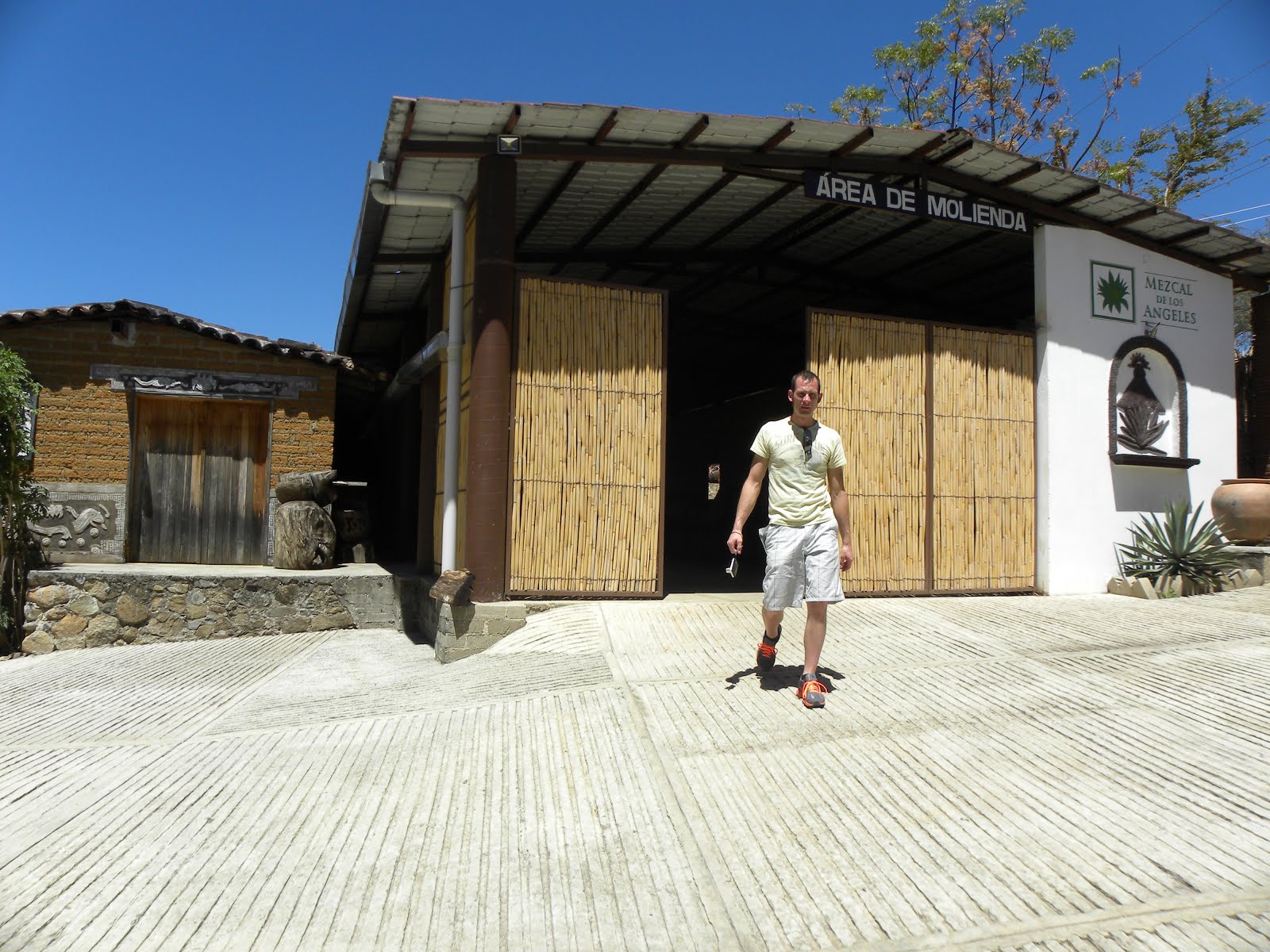
That day’s program began at the Real Minero mezcal distillery (palenque) and farm, located in a village out in the boonies. Our bus pulled up to a park next to the distillery, where a pickup basketball game was going on. When one of the teams scored, we cheered from the bus. The players didn’t react, so I wasn’t sure if they didn’t hear us or they were just trying to play it cool.

There were chickens on the grounds, and the ground was mostly dirt and liberally populated with agave plants, big ones. The buildings were either new and pristine or traditional and elaborate. According to our guide, there's a prejudice against rural people living well, but she said it's worth the hostility to make a nice space for their work.

The woman in charge of the distillery, Graciela, led the tour. Her grandfather made the unusual decision to leave his farm to her instead of a male relation. The only way to buy land in this place is to be born here. This custom is meant to preserve the sanctity of the land.
Liz with Graciela and Santiago

Land is sacred to the indigenous communities of Oaxaca. The earth is a living being, part of the family. On the way there, we saw stone-and-brick pedestals in the fields, placed in seemingly random spots. Graciela said those are where people perform rituals to ask for water or give thanks. Many rituals have disappeared, but some have survived. There are also 15 different ethno-linguistic groups in this area, essentially 15 countries in one territory. This leads to conflict over sacred spots.

Land belongs to everyone and no one. The community gives one day’s worth of planting to people who want to farm, approximately one hectare. Most farmers have around ¾ hectare. Where agave grows wild, the indigenous people who belong to that forest or mountain can harvest and sell it, but others can't. This farm only grows about 2% of the agave they use in the distillery.

The agave is native to Central America. Linnaeus named it after the Latin word for “admirable.” Maguey is the common name in Spanish. There's enough room for annual crops in between the plants, making it ideal for polycultures. Agave both gives seed and reproduces through the roots. They plant it by seed in small rows before moving it to its final field at the beginning of the rainy season.

Nolan at Real Minero
There are many varieties of agave, 200 total and 156 in Mexico, about 30% of which are in Oaxaca. The different varieties grow in different microclimates. The American agave takes 20 years to reach maturity and weighs up to 400 kg. Other types are much smaller, but most take at least 7 years to reach maturity. Some are good for putting on fences; others are best planted in circles in the fields.

Every part of the plant can be used. The flowers and stems are edible. Fibers can be extracted from the leaves and sugar from the heart. (Hidalgo is the state in Mexico where agave fibers are still used.) The leaves are also used as house roofs and the stems as house beams.

There are drinks derived from agave other than mezcal. Agua miel is the freshly extracted agave juice, full of vitamins like B-12. Pulque is a fermented beer-like beverage, mostly from the state of Puebla. Before the Spanish arrived, there was no milk, and pulque served a similar function. The arrival of beer killed the pulque industry in Mexico.

Pit where agave hearts are roasted.
Now corporations from Jalisco are buying all the agave they can find for miel de agave (agave nectar), which is not sustainable. In Jalisco, corporations also rent land to monocrop agave. (Monocultures showed up in Mexico in the 1940s.) The system is more tecnificado (mechanized). There are intermediaries (coyotes) now, so small farmers don't control prices.

Mezcal production was illegal until 30 years ago; various laws prohibited native drinks. Graciela's grandfather went house-to-house, selling in bulk. It takes 5 years to learn how to make mezcal, like going to college. This distillery started in 2006. They had to find work for women in the process as well as men.

The most valued agaves for mezcal are complex in flavor and aroma. There are usually mixed varieties of agave in each batch.

I smell El Dos ("The Two"). (Not poop.)
To make mezcal, the agave is always harvested at biological maturity. Six months after cutting the flower stalk, the heart is harvested. What is not used for mezcal can be used as fuel, leaving no waste.

The roasting oven is pre-Hispanic (pre-Columbian) technology. Rocks and coal are placed at the bottom of the dug-out cone. The rocks can absorb a lot of heat. They use large pieces of wood to make a hot fire. The wood they use is often donated or left over from forest management.

The rocks go over the fire, taking 10 hours to reach the desired temperature. Then they put fiber over the stones for insulation and agave on and around the fibers. Their oven has a capacity of 13 tons of agave hearts.

Graciela with distillation pot
The roasting agave is covered with a tarp (which can be made of palm leaves) and soil, with some water under the tarp. It cooks in five days. This process turns the starch to sugar and gives the mezcal a smoky flavor. It takes 5-8 people when done by hand. Since it takes about a month to make a batch of mezcal, they fire about twice a month to keep it flowing. The goal is to have constant work throughout the year.

Five days after taking the agave out of the oven, they grind it. The burnt and bad-flavored parts have to be trimmed off. Then, either 2 men work it over with big pestles (One vat takes 8 hours.), or they send it through a mechanical grinder. Agave is pretty acidic; we can see the evidence where the grinding is done.

The ground agave spends 3-4 days in the first container. Water is added on the 4th day. It takes 8-10 days to ferment after that. Both the fiber and the juice ferment; more mechanized processes extract the juice first. “Our processes aren't domesticated,” Graciela explained. fermenting, there's about 8% alcohol, and it tastes like beer.

Distillation pot
For each barrel they light 3 stills. They have to start the distillation at the right time; otherwise, the liquid will turn to vinegar. Distilling takes 2-3 days and nights. The process is called Philippine distillation, with 2 clay pots and a copper round-bottomed lid with cold water in them to create the condensation, which drips into a wooden spoon leading out of the pots.

There are 4 parts to the extraction: the punta, which they throw out because it has the wrong kind of alcohol in it; the heart; the tail and the last bit, which they use only to wash the floor. They get 55 liters per ton of agave with a good yield. Their distillation ends up with 38-55% alcohol. Sometimes they distill a second time, such as with mezcal de pechuga, for which they put dried fruit and a raw chicken breast in the second distillation.

They use the left-over fibers to mix with earth and make adobe, or make paper, forage, compost or fuel.

They never took loans from a bank, and all the profit is reinvested in the project.

Lunch at Real Minero
During the tour, Graciela’s little boy, Santiago, was hovering on the edge of our group, trying to peel people away one at a time to play with him. I was never picked as a potential playmate, which was a little disappointing. But I wasn’t really interested in the lecture, so I probably didn’t look like much fun.

We sat at a long, L-shaped table for lunch. There were 4 different flavors of mezcal for us to sample, a shot at a time. I had to stop after the third.

After lunch we returned to the hostel and discussed immigration. I talked about getting pissed off by my former employer, a certain large, financial octopus bringing Indian clerks to Minneapolis. I’ve been very reluctant to tell people about that, as detailed in an old blog post, My Job Made Me Racist. Strangely enough, I'd told Charlie about it the night before in our room as we were getting ready for bed.

That evening I joined Paul, Sara, Hannah, Nolan and Andrew (I think) to climb the hill that the hostel was at the bottom of. Somebody wanted to see the big amphitheater at the top. We’d asked Maggie about it the first (or 2nd) morning. She said it lost its cover because the construction company used shoddy material. Without that background, it looked like a fancy observatory instead of a glaring example of government corruption.

We climbed some steep, cobblestone streets through a poor neighborhood. Later, Maggie said if she'd known we were going up there, she would've suggested a different route, because it's a rough part of town. On one of the steepest streets, I looked into an apartment; the curtain covering the door had been pulled to the side. It looked poor, but they had some nice audiovisual equipment.

I wondered about their priorities or what goods and services have access to, assuming it was all acquired legally. Electronics may be more easily purchased (or stolen) than other, more basic necessities of the Good Life.

We had to walk under the last street to get to the amphitheater. There were murals in the passage, but I didn't recognize any of the historical figures included therein. The amphitheater turned out to be Oaxaca City's Inspiration Point. We kept passing teenage couples, most of whom were not making out, but they appeared to be looking for the right spot to start making out or waiting for us to pass.

We circumnavigated the place and took a different route back, down a long line of stairs lined with street lights, which was helpful since the sun had just set. There was a woman working in a garden along the path, with whom we spoke. Hannah did most of the talking, since she was the strongest Spanish speaker in the group. After the stairs, we weaved our way down streets, passing a building with a loud gathering inside that looked like either an evangelical church service or a game show.

There was also a currency exchange (casa de cambio) on our way. It was closed, but I was curious about the exchange rate, so I crossed the street to look. They had a chalkboard out front with the dollar-to-peso rates. It showed 16.66 pesos to the dollar, which was about 2 fewer pesos than the day before. I was struck by the volatility and the occurrence of “666.”

For dinner, I joined Andrew, Alan, Nolan and Hannah at El Trompo, a little taco place near the hostel. There was a TV showing a Mexican soccer match with several young men gathered around. I was concerned about the wait staff wearing masks. It didn’t fill me with confidence, but it was a common sight on street vendors and waiters in the city. I ordered a large dish called the Matahambre ("It kills hunger."), a name that proved prophetic. It was very good, basically everything on their limited menu, chicken, peppers and cheese with tortillas.

I switched to the downstairs shower on Day 2, but it wasn't until Day 3 that I realized the water dials were for hot and cold, respectively, knowledge of which considerably enhanced my showering experience.

I went to bed quite peacefully that night, little suspecting what fiendish plot was being hatched by the Mexican microbes that had recently gained residency in my gastrointestinal system. (Don’t worry; it wasn’t that gross.)